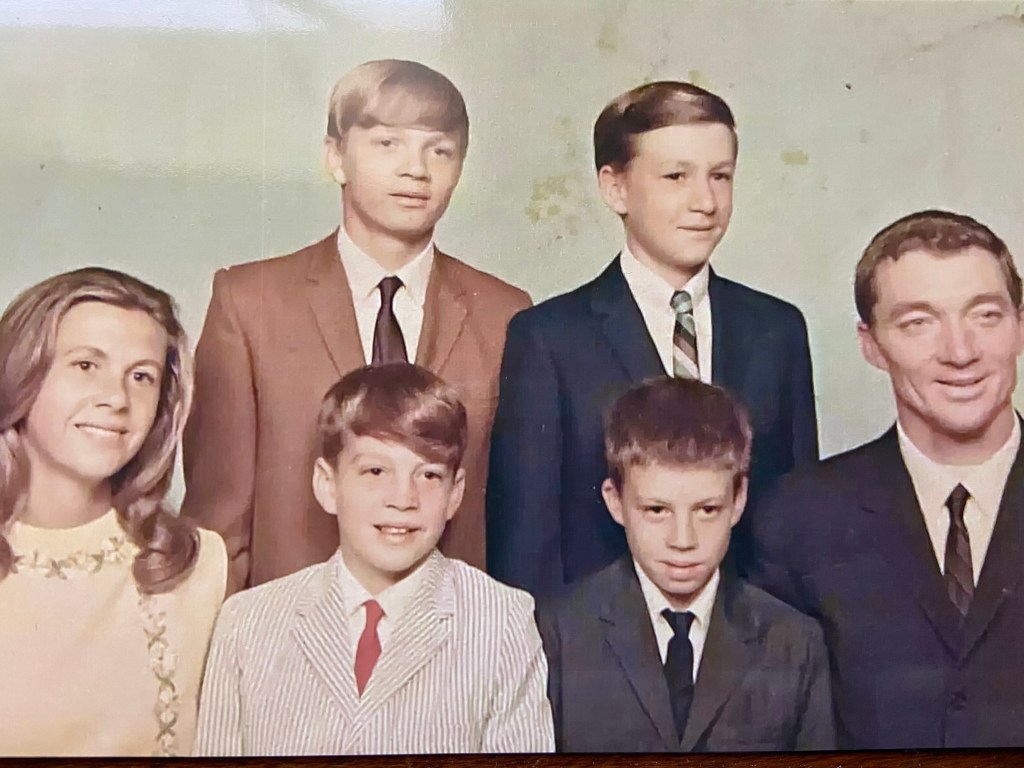
Mighty Mike
Whenever I talk about my Uncle Mike passing away, I always mention his age. He had just turned 49. Uncle Mike was my dad’s second to youngest brother. You know how most people have that exceptionally fun aunt or uncle growing up? Well, he was my exceptionally fun uncle. He was the epitome of the saying, “He’s just a big kid.” And I do remember him being big, especially when I was younger. Neither side of my family boast a lot of height, but he seemed so tall.
Uncle Mike was strong. One of my favorite memories is watching him do pull-ups. I’d had a sleep over at his house with my cousin, Rebecca. I was passing by his room to go downstairs in the morning and he was hanging from the rafters above his bed, doing pull ups. I pictured him as a competitor on the show “American Gladiator”. He had long wavy brown hair and wore a lot of tank tops. It seemed like he’d fit right in with Blaze and Nitro. He was always up for games of baseball and football. I still remember him convincing me he had alligators in his pool.
When I was in high school his behavior began to change. We all knew something was off but no one could convince him to go to the doctor. He became erratic and safety was a concern. He was taken to the University of Michigan Hospital after an altercation with the police. My cousins will detail this in later posts. I look back and wonder, if this happened today, would someone have caught all of this on their phone and if he’d be a headline.
This is a prime example of the reason to be kind to everyone you meet. My cousins would be in their early twenties and adolescence while this all spiraled out of control. You wouldn’t know it when you ran into them. And my uncle? You probably would have labeled him “crazy” or an “addict” after any brief interaction.
What presented like a schizophrenic episode turned out to be Frontotemporal Lobe Dementia, the same thing Bruce Willis was diagnosed with in 2022. Uncle Mike was 48 at the time. His death would happen less than one year after diagnosis.
Frontotemporal Lobe Dementia, also known as Pick’s Disease, is most common in middle-aged adults, with 60% of patients being in the age range of 45-64 years old (National Institute on Aging). This form of dementia makes up 10-20% of all dementia cases (Association of Frontotemporal Dementia). There’s no cure for FTD and no way to slow down its progression. Once it’s diagnosed, there are only treatments to manage symptoms. Changes are seen in behavior, speech and muscle control. FTD presents itself much more like a psychiatric illness as the frontal and temporal lobes of the brain are atrophied. I always say dementia in any form or at any age is a cruel thief.
The visit
My uncle was eventually moved from the hospital to a nursing home. His speech was quickly disappearing. His strength began to fade. He was more confused and his understanding of things became childlike. It took me awhile to work up the courage to visit him. I asked my grandparents if I could ride along with them one Sunday after church. I wasn’t sure what to expect.
We arrived at the facility with some snacks for him. The facility was dimly lit and no one was at the front desk to greet us. We signed in and began to walk down a hallway that seemed to go on forever. It felt deserted. As we approached the double doors leading to his unit I realized the doors were locked. My grandparents entered the code and we filed in one by one, making sure the doors shut behind us.
His room was right across from the nurse’s station. As we walked towards his room several other residents came to greet my grandparents. My grandparents called them each by name, told them they loved them, reminded them they were loved by God and asked how they were. My grandma, especially, stopped to listen to how they really were. People with faces covered in tattoos and missing teeth and different ethnicities and abilities.
I had never been in a place like this before and my grandparents made it seem like home.
It was clear Uncle Mike’s unit was more of a psychiatric unit than a typical nursing home unit you’d expect. I was shocked by how young some of the residents were and noticed those talking to themselves. Some of their clothes were worn so thin because no one had brought them anything new in ages. This isn’t my speculation. As we spent time there, especially the last few days of his life, we learned that many of the residents had no visitors or very limited contact with their families or the rest of society. It’s why my grandparents became their family.
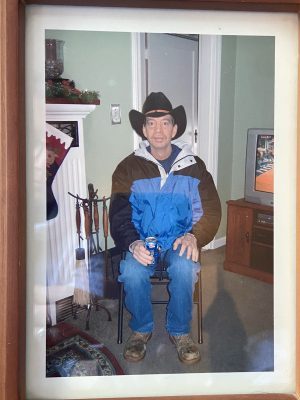
When we eventually got to Uncle Mikes room he was dressed with his coat on, as if he might leave. He was wearing his black cowboy hat. Most of his erratic and aggressive behavior had ceased by this point and seemed to leave behind a docile soul we knew and loved, but unable to communicate. Instead of reaching out for a hug as he would have, he extended his hand. So I took it and he held onto it for several seconds, keeping eye contact with me smiling. He did this several times throughout our visit as if to say, “I’m glad you are here.” I can still picture that smile on his face.
After sharing updates with him and admiring his pictures of the Dallas Cowboys stadium Rebecca had taken for him, his friend wheeled himself into the room. One leg was propped up and one eye droopy. He was excited to see my grandparents and the snacks. He visited with us for a while, talking about eating glue and believing the side of his body that appeared to be affected by a stroke was robotic. Then it was smoking time. The aide came by and unlocked the smoking room. Just a room with concrete walls, a fan to pull the smoke out, some folding chairs and a TV. It reminded me of a dive bar on a Saturday night.
Eventually it seemed like Uncle Mike had forgotten we were there. He sat back down in the chair and stared at the wall. My grandparents talked to him. I told him a little bit about college. As we were leaving, my grandparents hugged him, told him they loved him and reminded him, “God loves you. He is always with you, even when we’re not.” He sat motionless in the chair with zero response to their voice or touch.
We left the room and I turned around to look at him and tell him I loved him.
And almost as if an audible voice spoke to me, I heard the Lord whisper, “Do you see them? Do you see my forgotten people?”
I only saw my Uncle one more time after this before he began his transition out of this world. After a trial run of visiting my grandparents house, accompanied by his favorite aide, we were able to bring him to my parents house for the big family Christmas. He was wearing that black cowboy hat and coat. He didn’t say or eat much. He was losing some coordination. We watched the Pistons play the Pacers. He smiled A LOT.
Uncle Mike fell on Super Bowl Sunday 2005. We’d only have a few more days with him. It was my first exposure to hospice. I remember so many of us camping out at the nursing home. I can still picture my cousins at his bedside, wiping the sweat from his forehead, holding his hands and telling stories. At the time they were 23, 20 and 12.
Going to the funeral home for my Uncle’s visitation was the first time I ever saw my grandpa cry. Another man of great strength, he almost seemed to struggle to stay on his feet. My grandma aged exceptionally well, but the difficult year seemed to age her 10 years. I have absolutely no idea how my cousins were able to hold themselves up during all of this, but they will share their own experiences in the next posts.
When we were waiting outside the funeral home before leaving for the cemetery I hugged my grandma.
She wiped her eyes and said, “God is good all the time. All the time God is good.”
“do you see my people?”
I instantly had questions after my initial visit. Other than my grandparents, who was reminding these people that they were loved and created with purpose? What kind of effect did being shut out from the rest of the world have on their mental health? What are their stories? Everyone has a story. And okay, God, but now what? Have you ever had an experience like that? One where you know God is stirring something but there’s no road map?
Prior to losing Uncle Mike, I’d committed to spending Spring Break in the warmth of the South Side of Chicago. I’d hesitantly go, due to grief, spending the week volunteering at various places. This trip would solidify that Jesus was calling me to follow Him into social work and not education. Chicago stole my heart and it became my preferred way of spending Spring Break. There was nothing logical about me feeling at home in any of these settings. A girl who grew up raising pigs, driving 4 wheelers and never experienced being the minority anywhere she went, wouldn’t seem to “fit” into the city. This turned into me giving the first five years of my social worker career to the unhoused and unseen.
The way in which Jesus works isn’t always logical. The way in which He seemed to choose His disciples wasn’t logical. Miracles aren’t logical- that’s why they’re miracles. The way God chose to speak to Moses and Saul changing to Paul wasn’t logical.
If all we needed was logic, we wouldn’t need faith.
We have a choice in how we follow Jesus or if we follow Him at all. We have a choice in the moments when the Holy Spirit seems to be prompting us to change things. My grandparents had a lot of different life experiences, someone could make a movie about their lives. But in all the places they went to, nothing prepared them for the spaces and situations they’d find themselves in. No parent is prepared for their child to receive a terminal diagnosis, at any age. Yet, they lived out the faith they’d been teaching us all along.
It’s easy to show up to church on Sundays and check the boxes, post the right things on social media. But we have to ask ourselves, if our worlds crashed down tomorrow, would our foundations hold? If God called us into the unfamiliar or an illness or job loss brings us to painful territory, would we have spent our time in such a way that we’d be ready for it? Could we stare tragedy in the eye and state, “God is good all the time. All the time God is good.”
What foundation are you building your house (life) on?
 standing with hope
Leave a comment