By Sarah Swogger
Hi. My name is Sarah and I’m an alcoholic.
Wait. I can do that better; let me start again.
Hi. My name is Sarah, and I am a person in long term recovery, which for me means I have not had alcohol in six years. As of today, this very day. Thank you, thank you! In all honesty, I would love to accept your congratulations, but I must insist that it is not I who deserves your praise. In fact, I spent the better part of ten years crouched down in the dark, hiding, white knuckling my long island iced tea and resisting any invitation of hope and restoration. Living now on the other side of that chasm, I can share my recovery journey from start to present with the added benefit of hindsight. Below I have compiled the three main insights that I have gleaned along the way. I present them in the hopes that my suffering may be redeemed to minister to those still stumbling around in the darkness. As I mentioned, it is not I who should be celebrated or admired. If nothing else, I hope to communicate today who it is that truly does deserve your praise, adoration, and devotion.
Alcoholism is not one-size-fits-all.
The day that I shared I was an alcoholic publicly, the reaction I received from many people was shock. An alcoholic?! You?! I must admit that if I had been on the outside looking in, I may have had a similar reaction. My life was not falling apart. I was a confessing believer in Jesus and active in my church community, celebrating nearly five years of marriage, graduating Grad School and gearing up to start my career as a Kindergarten teacher. Unless you were my husband or my close friend, there were really no detectable indicators that I was living in addiction.

My drinking habit began after I turned 21 when alcohol became easily accessible. I have no villain origin story or childhood tragedy to explain or justify it. I just like being drunk. So much so, in fact, that as time progressed, I began to drink quite heavily and with much regularity. Whenever I drank, anxiety would creep up my spine and settle into my chest as the night waned. Everyone would go to bed and I would desperately wonder when can I drink again? I don’t want this feeling to ever stop.
For most of my journey, alcoholism did not look like a life in tatters. It was much more insidious than that. It was a quiet ache in my soul. It was a tormenting force that whispered to me at the start of every week and by Friday it was screaming at me. I couldn’t cover my ears, I couldn’t drown it out. The only way to quell the anguish was to drink again.
I did not know, at the time, that this is what alcoholism could look like. I thought I certainly could not be an alcoholic because my life, for all intents and purposes, was fine. In fact, in many ways it was great! Please hear me when I tell you that alcoholism is not one-size-fits-all. The ways in which addiction manifests itself into our lives may not be predictable, consistent, or comparable. At one of my first AA meetings I refused to say “I am an alcoholic,” instead opting for “I have a problem with drinking too much sometimes.” I genuinely believed that because I did not drink every day or because I did not drink to excess every single time, I could not be an alcoholic. I wasn’t homeless, I wasn’t jobless, I was educated and driven. A very gentle woman proceeded to introduce herself as an alcoholic and then explain to me that her drinking pattern was exactly like mine.
It may have taken me much too long to admit it aloud, but I knew. I knew every sick and sorry morning after, that what I was doing would eventually consume me. I knew with each passing week that I was losing grip; that what I once deemed a choice was now a demand. I knew I needed out, but it was dark, and I didn’t know the way.
Drowning.
In the days before I was willing to call a spade a spade, I thought I could simply manage my problem. Since I surely wasn’t an alcoholic, I figured I could just drink less. I tried a few different variations of moderating, each one no more effective than the last. I set a limit on the number of beers I could drink in the evening. I set a cut-off time for when I had to switch to water. I swore off liquor altogether. And yet, even if I could manage to stick to one of these goals in a given night, it was utterly agonizing and unsustainable. There were times I even cried because I wanted to drink more.
When moderation failed me, I thought perhaps abstaining completely for a set amount of time would do the trick. That way I could prove that I didn’t need it, I simply enjoyed it on occasion. My longest streak of self-sustained teetotalling lasted a grand total of three months. That was long enough.
These tactics illustrate a person out at sea, tossed violently amid the waves, gasping for breath and insisting they can make it back to shore alone. I believed that by changing my behavior, I could save myself. I was frantically changing outwardly when what was required was inward restoration.
When you are the one drowning, you cannot throw yourself a life preserver.
-sarah swogger
I was a believer, yet I was willing to death-grip this sin straight to the grave. Jesus could have control over every facet of my life, except this one. God was beckoning me, over and over and over. He told me, it does not have to be this way. I heard Him; but I knew listening and obeying would come at a great cost. Eventually, a glaring choice lay ahead of me: accept His invitation or sink.
Your recovery may not be linear.
The first time I shared with other Christians that I was struggling with alcohol was in the summer of 2014 while we were on a mission trip in Zambia, Africa. I cannot explain it other than a prompting by the Holy Spirit as it was not on my agenda to share my deepest held secret with anyone…ever. And from that day forward, I never drank again.
Got ya! I did stop drinking for a little while, but sure enough as the torturous reality of sobriety sank in, I slowly slipped back into my old, comfortable habits. Seeing all things clearly now, this was certainly my first step toward recovery, but what I didn’t know is that your recovery may not be linear. It may be a clean, straight line forward for some; but for so many others and for me, it is jagged and ugly.
As I continued to drink, now with a deeper gnawing in my heart having shared the truth with others, a tragedy befell my family. In March of 2016 my 31-year-old brother, Anthony, shot himself in our childhood home where he still lived with my Mom. Whatever problem alcohol was before in my life, multiply that by infinity. Grief-stricken and utterly depressed, I drank with reckless abandon, daring anyone to say something to the girl with the brother who killed himself. I cared for no one but myself. I know now that such selfishness was born from deep suffering, but it does not justify my behavior in the year and a half that followed his death. I began to drink in excess of 20 beers a night. I drank and drove. I expanded my abuse to other mind-altering substances. I was places I never should have been with people I never should have been with. And I lied about it all.

In the Spring of 2017, as my life spun wickedly out of my control, I hit the proverbial wall. I remember it vividly, sitting in the car after another night of binge drinking, scraping my knees against rock bottom. I have always described it as the feeling that my soul was tearing in two. I could sink no lower, I was mired in the pit. And so, from the depths, I cried out to God. I admitted it all. I said it out loud. I am an alcoholic. God, please save me. I cannot save myself. I will either stop drinking or I will die. And from that day forward, I never drank again.
Did I trick you again? I did, at this time, truly admit to everyone that my situation was far worse than I had led them to believe. I did commit, by the grace of God alone, to never drink again. No more moderation, no more fasts, no more outward behavior modification. And yet, after 42 days of sobriety I found myself in a situation that led to me breaking that promise. My husband, Jake, had gone to Guatemala with an inner-city ministry. Without him near, I faltered. Early sobriety is unspeakably difficult, and relapses are common.
But I can most assuredly tell you now that a relapse is not the end of recovery, it is just another curve in the path.
-Sarah swogger
On August 4, 2017, I begged God once again to save me. I had tasted freedom and I had run from it. I was ready to come back home. I held my hands open, offering nothing to Him. And in return, He gave me everything. Have you read the parable of the prodigal son? Did you know that the father in the story RAN to greet his beloved child? That he conducted himself in a highly undignified manner at the pure joy of embracing his once lost son? He lifted me from the darkness, and he held me there in the light, just as I was. And from that day forward, I never drank again.
It is enough for you.
As I walk through life as a person in long-term recovery, I am acutely aware of the undeserved blessings that are now my reality. God restored what I had carelessly thrown about in my addiction: my marriage, my friendships, my passions, my joy. He has given me three unbelievably beautiful children, Anthony Jude, Eden Constance, and Reid Marylane. And now it is my sincere prayer that He would use my story, my suffering, my song of His hope, to ring out into the darkness where someone may yet be staggering just as I was. His grace was enough for me. It is enough for you.
And I am here with an outstretched hand, ready to walk alongside you into the light.
-sarah Swogger
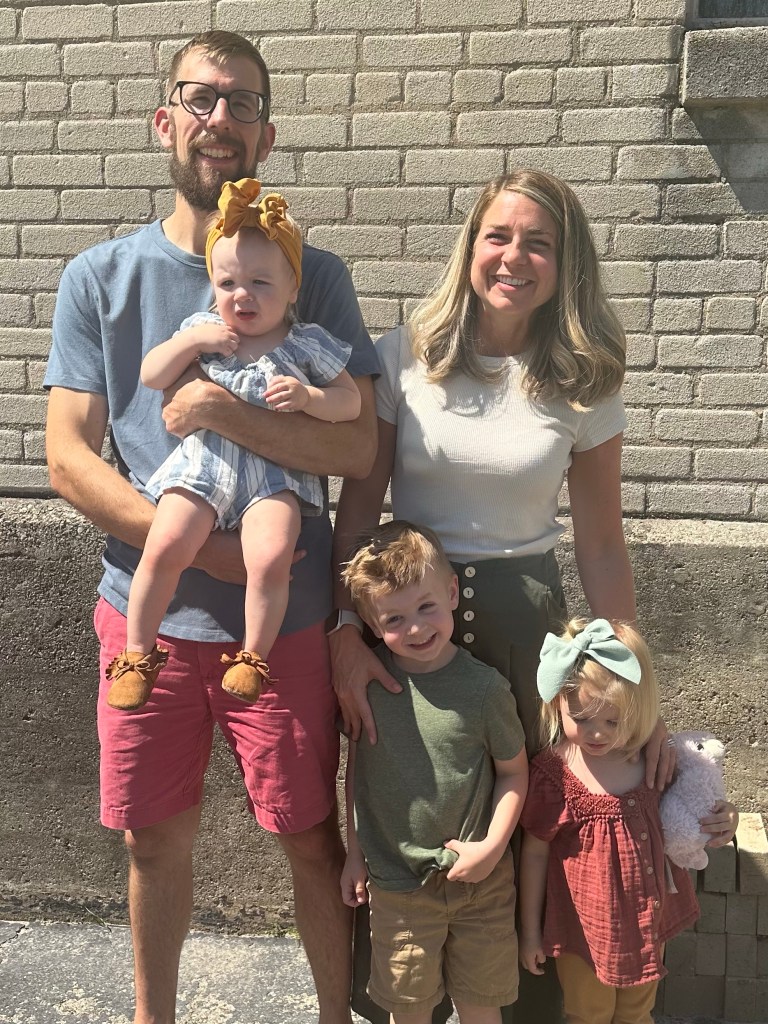
 standing with hope
Leave a comment