by molly klima
If you know me or have been around the blog for a little while, you know that my husband and I grew our family through adoption. Adoption was always a part of our plan to grow our family. What we didn’t know was how or when. We were foster parents for three years, taking in 6 kids. In 2014, we finalized three adoptions and decided to let our licence lapse and pour everything we had into our three sons. You can read more about what lead us on this road in my post “I Could Never”.
I often say that adoption is one of the most bittersweet human experiences. It’s born out of necessity and loss. There is no “ideal” situation in which a woman carries a child for 9 months but does not embark on the parenting journey with that child. Adoption is not the solution to abortion or the way communities heal from the inside out. Adoption is not charity or easy. Adoptive parents are not saviors or people who have a “special place in Heaven”. We are just as flawed as everyone else. We don’t claim to be adoption experts. There is a higher likelihood that our children have special needs. There are some unique challenges in regards to trauma and loss. But we are still just parents trying to do the best we can for our kids, whether they share our DNA or not.
Adoption is sweet in that a child has a family to grow old with, which every child should. I know that everyone will agree with that statement, despite the fact that there are over 100,000 kids in the US foster care system waiting to be adopted, who cannot return to their biological families. Adoption can provide stability, opportunity and safety that may not otherwise take place. As one of my children once said, “Adoption was the safer choice, not necessarily better.” This came from a place of him acknowledging that it would have been great if adoption and foster care weren’t a part of his story at all. Kerry and I have always said that base case scenario is that families are restored without permanent separation. To say they are better off with us is to say that their first families would have no value to add at all. That’s not true. It’s incredibly complex and the dynamics in every situation are different.
Say what
When we see a family that looks like ours, Kerry likes to make it a point to tell them, “You have a beautiful family.” It seems like an easy and kind statement. Most adoptive families don’t receive those comments, especially from strangers. These are the comments and questions we, and every other adoptive family we know, receive on a regular basis. Get a group of us in a room together and we have some wild stories! There’s a good chance you may have said some or all of these to us, that’s okay. I think a lot of times these come with good intentions, I don’t ever want to discourage anyone from asking questions about adoption or foster care. It’s one of Kerry and I’s favorite things to talk about. We love it. I’m just encouraging anyone reading this to stop and think before you ask quesitons or comment about specific families and birth parents.
- “They are so lucky to have you” or “They are so blessed to have you”. I know the sentiment behind that is meant to be encouraging. Your glad our kids are in our family and they are healthy and safe. Me too. I am glad that we can provide the life we are able to for our sons. There are days where I am overwhelmed with gratitude to the point of tears and some moments take my breath away. Not the big moments, just the regular, everyday moments of being in the kitchen and hearing their laughter or their peaceful faces when I wake them in the morning. I am honored and humbled to be able to do this. It’s a privilege to be their parents. In order for adoption to take place, there had to be loss and for some great trauma. There’s nothing lucky or blessed about that.
- “At least you got them when they were young so they don’t have any issues.” If you ask Kerry, this is his biggest pet peeve when it comes to comments. It is a common misconception that children who are adopted as babies or toddlers will have no long-lasting effects of trauma. Science and experience disprove this. Major brain development happens in the first three years of a child’s life. Trauma can stunt brain development and/or brain growth. It literally changes the ways their brains are wired, the amount of stress chemicals produced and can result in hyperarousal, developmental delays, poor emotional regulation, regression and more. Adoptive parents often don’t parent in a traditional way. Our kids may dsiplay difficult behaviors that strangers deem “bratty” or over the top, don’t judge us, or our kids. Sometimes they are just being over the top, for sure. Sometimes they are in a state their brains can’t regulate.
Their behavior may seem like a typical, unruly kid but the root may be different.
Trust we are doing the best we can and there’s a lot we’ve done to figure out the best ways to help our kids heal and succeed. More than the public will ever see.
- “Skin color or race doesn’t matter”-this is true in the sense that we love our kids unconditionally regardless of their skin color. However, this actually has quite an impact for us as a transracial family. There are obvious things, like hair and skin care. Both of those require different products and techniques than ours. These are things that we have spent a lot of time and money on trying to figure out and educate ourselves about. Add in racial slurs, cultural awareness and seeing the world in a diffferent lens. It actually makes a big difference. This will eventually have a post of it’s own.
- “Was their mom on drugs?” This is probably the number one question adoptive parents get. First, this is no one’s business. Second, there is clearly a stereotype for women, not as much for men, who choose to or are not able to parent their children. There’s typically an emphasis on mom doing drugs and dad being a mystery. Neither of those are fair. It may seem obvious, but please don’t expect adoptive parents, especially those you just met at the park, to explain these things to you.
- Last but not least, probably my personal favorite:
“Are they real brothers?”
“Yes”
“No, like are they real brothers? You know what I mean.”
Listen, I do know what you mean. You’re asking if they share DNA. Genetics and “real brothers” are not the same thing. If they are not real brothers then we are not their real parents. Other than the fact that we would probably not be asked this as often if our kids were all white and didn’t have varying skin tones, it is rude. The most frustrating thing is when people ask this right in front of our kids. As if they aren’t old enough to understand the question or cannot hear it. If you do ask this in front of them, you can expect to watch their faces scrunch with confusion and look at each other, and then look at us as if to ask, “Why would they ask that? What is wrong with them?” They know our family dynamics. The knowledge of this has no value for the person asking. If you ask an adoptive family this, and they tell you “Yes.” That’s the asnwer. That’s it.
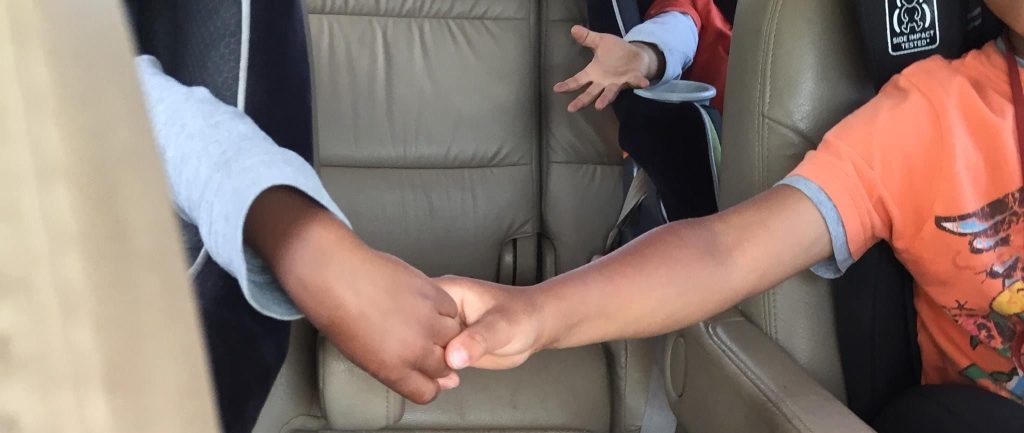
I’ll tell you what real is. Real is fighting like cats and dogs one minute and snuggled up to each other on the couch the next. Real is the younger brother coming to get our attention because kids are leaving the older brother out. Real is the concern they have when someone has an emergency. Real is being ready to defend each other when the odds are stacked against them. Real is when they correct each other if they are putting themselves down. Real is barely making it through a game of wiffle ball because they must be better than each other. Real is dressing alike when we play sports as if they are on an official team. Real is yelling, “BROTHERS!” when one of them needs to summon the rest for something exciting. Real is wanting to sleep over in each other’s rooms. Real is moving into a 4 bedroom house and still wanting to share a room when they could finally each have their own. Real is being ready to tattle on each other after school. Real is the compassion that is shown when we talk about a diagnosis. Real is knowing each other’s likes and dislikes and being able to pick out their brothers favorite items at the store.
Real is shouting, “I LOVE YOU!” from the stands just to try to embarass their brother…and because they mean it.
In no way do I want to discourage people from learning more about adoption and foster care. I think everyone, including us, has things to to learn. My heart’s desire is for an increase in critical thinking in everyday interactions and conversations. Curiosity is great, but words and context matter. Kerry and I are always willing to discuss foster care and adoption, we believe the Church is in a unique position to play a vital role in strengthening and growing families.
 standing with hope
Leave a comment